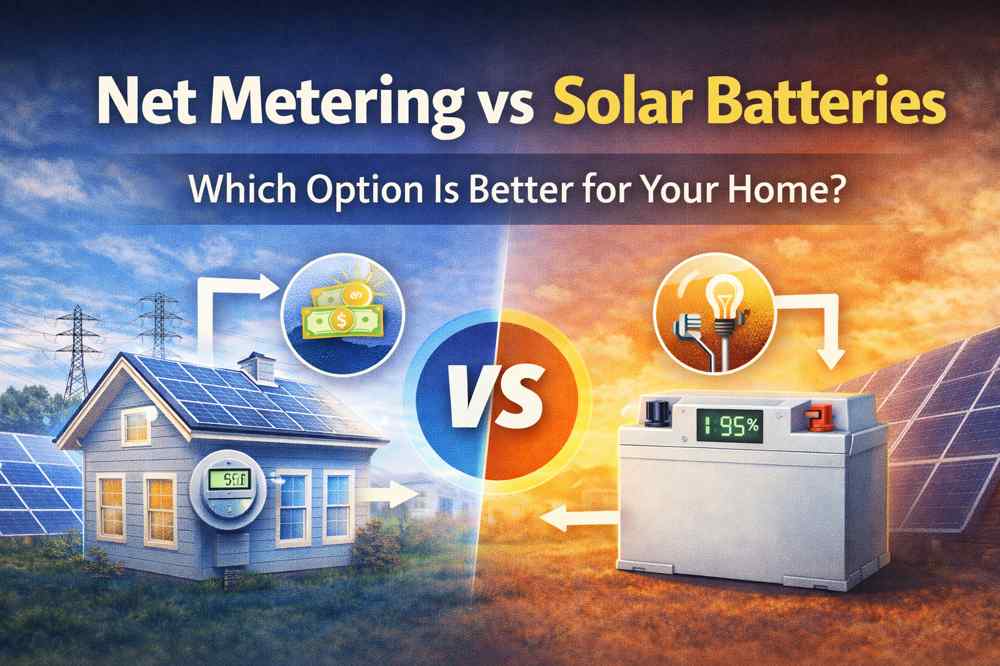

As solar adoption grows, homeowners are increasingly faced with an important decision: net metering vs solar batteries—which option is better?
Both approaches manage excess solar energy, but they work in very different ways. Net metering allows you to send unused electricity back to the grid in exchange for credits, while solar batteries store that energy for later use.
Understanding the differences between these two options is essential for optimizing your solar system and maximizing long-term value.
To understand the comparison, it is important to first look at how net metering works and how utilities compensate excess solar energy.
Net metering is a billing system that allows homeowners to export excess solar energy to the grid.
In return, you receive credits from your utility provider.
Key characteristics:
Net metering effectively turns the grid into a virtual battery.
Solar batteries store excess energy generated by your solar panels.
Instead of exporting energy, you keep it for later use.
Key characteristics:
Solar batteries offer a different approach by storing energy locally. Learn more in solar batteries: how they work & why you need one.
Advantages:
Disadvantages:
Advantages:
Disadvantages:
Net metering is ideal when:
In these cases, the grid functions efficiently as your energy storage.
Solar batteries are ideal when:
In these scenarios, storing energy locally becomes more valuable.
According to the U.S. Department of Energy, energy storage plays an increasing role in grid stability and resilience.
Across the United States, net metering policies are changing.
Key trends:
As a result, batteries are becoming more attractive.
Homeowner A:
Homeowner B:
The better option depends on local conditions.
Many modern systems combine both:
This hybrid approach provides flexibility and optimization.
These mistakes can lead to suboptimal decisions.
Today’s solar systems are becoming more dynamic.
They are designed to:
This makes flexibility increasingly important.
Net metering policies vary significantly by state. You can check current programs on DSIRE (Database of State Incentives for Renewables & Efficiency).
Choosing between net metering and batteries depends on your goals and local conditions.
Preconfigured systems help ensure compatibility and optimal performance.
AceFlex provides carefully selected solar panels, inverters, batteries, and DIY solar kits designed for residential solar systems in the United States.

So, net metering vs solar batteries—which is better?
As energy markets evolve, many homeowners are shifting toward battery storage to reduce dependence on utility policies.
The best solution often combines both strategies.

It depends on your utility policy. Strong net metering favors grid export, while weaker policies favor batteries.
Not entirely, but they are becoming more important as policies change.
Yes, many systems combine both.
Net metering often has faster ROI, but batteries offer long-term value.
Yes, batteries provide backup power, while net metering does not.