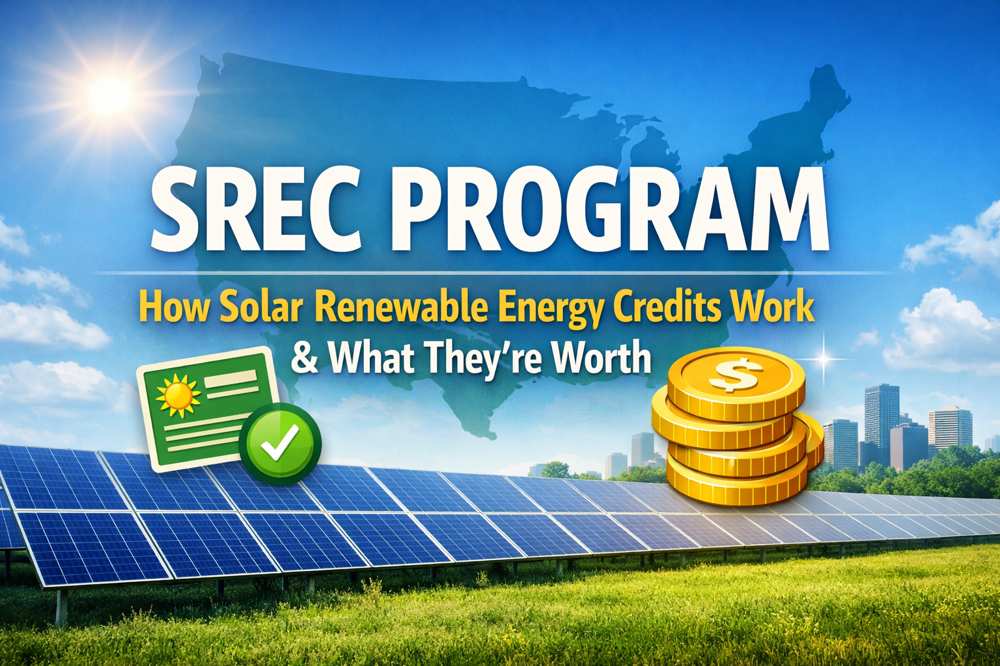
The SREC program is a policy-driven market mechanism designed to promote solar energy generation at the state level. An SREC, or Solar Renewable Energy Credit, represents the environmental value of one megawatt-hour (MWh) of electricity produced by a qualifying solar system. Utilities and electricity suppliers purchase SRECs to comply with state renewable energy requirements, creating an additional revenue stream for solar system owners. As a result, the SREC program plays a key role in improving the financial viability of solar projects.
Under an SREC program, a solar system earns one SREC for every megawatt-hour of electricity it generates. System production is tracked through certified meters and reported to a state-approved registry. Once issued, SRECs can be sold on an open market, either directly to utilities or through brokers and aggregators. The market-based structure means that SREC prices fluctuate depending on supply, demand, and state-specific compliance targets.
Participation in an SREC program is typically open to both residential and commercial solar system owners, provided the system meets state eligibility requirements. These requirements often include minimum system size thresholds, approved metering equipment, and formal registration with the state’s SREC tracking platform. While program rules vary by state, most SREC programs are designed to include smaller residential installations as well as larger commercial projects, allowing a broad range of solar owners to benefit from SREC revenue.
The SREC program is governed at the state level, which means eligibility rules, compliance demand, and market depth vary significantly across the United States. Here is an overview:
| State / Jurisdiction | Program Type | What You Monetize | Registry / Market (Typical) | Quick Note |
|---|---|---|---|---|
| Washington, DC | SREC market | Solar RECs (SRECs) | PJM-GATS | Strong compliance-driven demand in many periods |
| Delaware | SREC market | SRECs | PJM-GATS | Rules can differ for in-state vs. out-of-state systems |
| Maryland | SREC market | SRECs | PJM-GATS | Compliance market; pricing can be cyclical |
| New Jersey | SREC / successor incentive structure | Solar credits via NJ mechanisms | State program + tracking | NJ is a flagship market; program structure evolved over time |
| Ohio | SREC market | SRECs | PJM-GATS (commonly referenced) | Often referenced for cross-border selling from nearby states |
| Pennsylvania | SREC market | SRECs | PJM-GATS | Market liquidity varies; check eligibility carefully |
| Massachusetts | REC-based (legacy SREC history) | MA solar/renewable certificates | NEPOOL-GIS | MA is often cited in SREC context; program frameworks evolved |
| Illinois | Similar (REC procurement / structured program) | Solar RECs (procurement/contracting) | State program structure | Often treated as “SREC-like” due to REC monetization model |
| Virginia | SREC / REC-based compliance pathway | Solar RECs | Varies (check program rules) | Verify current eligibility + buyer landscape |
| Connecticut | Similar (Class I RECs) | RECs from renewable generation (incl. solar) | NEPOOL-GIS | REC value depends on class eligibility & demand |
| Rhode Island | Similar (RECs via registry) | RECs (incl. solar) | NEPOOL-GIS | Often monetized via aggregators/REC managers |
| New Hampshire | Similar (RECs via registry) | RECs (incl. solar) | NEPOOL-GIS | Solar systems can register to create RECs |
| Maine | Similar (Class I RECs) | RECs (incl. solar) | NEPOOL-GIS | Eligibility can depend on technology/vintage |
| Vermont | Similar (RECs) | RECs (incl. solar) | NEPOOL-GIS | Often handled through REC aggregation |
SREC prices are market-based and can fluctuate substantially depending on supply, demand, and state-specific renewable energy targets. Historically, SREC prices have ranged from $5–$20 per SREC in oversupplied markets to $200–$450 per SREC in states with strict solar carve-outs and limited supply. In premium compliance markets such as Washington, D.C., prices have at times exceeded $400 per SREC, while states like Ohio and Pennsylvania typically trade at the lower end of the spectrum.
For homeowners, a typical residential solar system producing 6–10 MWh per year may therefore generate anywhere from $60 to over $2,000 annually in SREC revenue, depending on the state and market conditions. While this income can materially improve project economics, it should be treated as variable and not guaranteed over the full system lifetime.
The SREC program and net metering address different components of solar project economics and are often complementary. Net metering directly reduces electricity costs by crediting excess generation against utility consumption at or near retail rates. The SREC program, by contrast, monetizes the environmental attributes of solar energy through tradable credits sold to utilities for compliance purposes.
In states where both mechanisms are available, solar system owners can benefit from lower utility bills through net metering while simultaneously generating additional cash flow through SREC sales. This combined structure can significantly shorten payback periods, although SREC revenue should be viewed as an upside component rather than a fixed financial return.
Whether the SREC program is worth it depends largely on the state, market maturity, and the role SREC revenue plays within the overall project economics. In high-value markets, SRECs can significantly reduce payback periods and improve internal rates of return, particularly for residential systems with moderate electricity consumption. In lower-priced markets, SREC income is typically incremental but still contributes positively to long-term system performance.
From a risk perspective, SREC revenue should be treated as a variable, policy-driven income stream rather than a guaranteed return. Regulatory adjustments, changing supply dynamics, and evolving renewable targets can all influence future prices. When integrated conservatively into financial planning, however, the SREC program can meaningfully enhance the economic resilience of a solar investment.
AceFlex supports SREC-eligible solar projects by focusing on system designs that align with state-specific compliance requirements and long-term performance goals. This includes selecting certified components, optimizing system sizing for efficient SREC generation, and ensuring compatibility with approved metering and reporting standards.
For customers pursuing DIY or component-based solar solutions, AceFlex provides modular system configurations that simplify planning while maintaining regulatory flexibility. By combining high-quality equipment with transparent system design, AceFlex enables homeowners and businesses to position their solar installations for both energy savings and potential SREC revenue.
The SREC program is a central component of the solar incentive landscape in several U.S. states and can materially improve the economics of a solar investment when applied correctly. By monetizing the environmental attributes of solar electricity, SRECs create an additional revenue stream on top of electricity bill savings, helping solar system owners offset upfront costs and accelerate payback timelines.
At the same time, the SREC program is inherently market- and policy-driven. Prices can fluctuate significantly based on regulatory targets, supply growth, and utility compliance demand, which means SREC revenue should be modeled conservatively rather than assumed as guaranteed income. A clear understanding of state-specific rules, eligibility requirements, and market maturity is therefore essential before relying on SRECs as a core financial pillar.
When integrated into a well-designed solar system with realistic financial assumptions, the SREC program can enhance long-term project resilience and overall return on investment. For homeowners and businesses alike, SRECs should be viewed as a strategic upside that complements net metering and energy cost savings—rather than a standalone incentive—within a broader, forward-looking solar strategy.

The SREC program is a state-level incentive mechanism that allows solar system owners to earn Solar Renewable Energy Credits for each megawatt-hour of electricity their system produces. Utilities purchase these credits to comply with renewable energy mandates, creating a market-based revenue stream for solar generators.
The value of an SREC depends on the state and current market conditions. Prices can range from under $20 per SREC in oversupplied markets to several hundred dollars per SREC in states with strict solar carve-outs and limited supply.
Yes. In most states with an active SREC program, residential solar system owners are eligible to sell SRECs as long as their system is properly registered, metered, and certified according to state program rules.
SRECs are generated based on electricity production. One SREC is issued for every 1 megawatt-hour (1,000 kWh) of solar electricity produced. Depending on system size, this may result in multiple SRECs per year.
No. Only a limited number of states operate true SREC markets. Other states may offer alternative REC-based incentives or fixed procurement programs that serve a similar purpose but function differently.
Yes. In many states, SREC revenue and net metering can be combined. Net metering reduces electricity bills, while SRECs generate separate income from the environmental value of solar production.
No. SREC prices are market-based and can fluctuate over time due to policy changes, supply growth, and compliance demand. They should be treated as variable income rather than guaranteed returns.
In most cases, SREC earnings are considered taxable income. Solar system owners should consult a qualified tax professional to understand reporting requirements and potential tax obligations.
Program duration varies by state. Some SREC programs have defined lifetimes or transition plans, while others evolve into successor programs. Long-term policy visibility is an important factor when evaluating SREC revenue.
Not necessarily. SRECs can be sold directly to buyers or through brokers and aggregators. Aggregators simplify administration but typically charge a fee or retain a portion of the SREC value.